

March 2026 became a record warm month, ranking 1st in the ranked series of observations from warmest to coldest since 1945. The average air temperature for Belarus was +5.8 °C which is 5.0 °C above the climatic norm. At 90% of stations, the previous average monthly air temperature records from 2007, 2014, and 2025 were broken. Previously, the warmest Marches occurred in 2007 and 2025 with average monthly air temperatures of +5.2 °C.
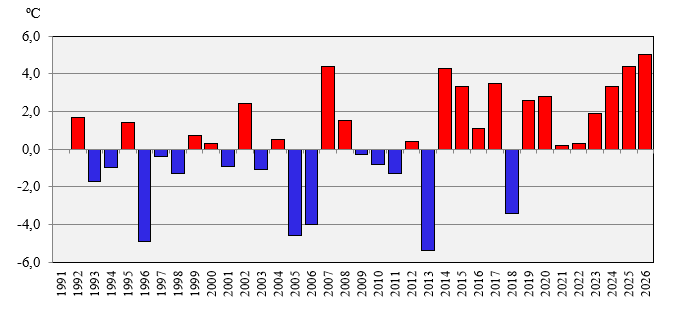
Deviation of the average March air temperature for the period 1991–2026
from the climatic norm (+0.8 °C)
The positive air temperature anomaly extended across the entire country and generally ranged from 4.8 to 6.0 °C.
By region, the largest positive deviations of air temperature from the climatic norm were recorded in the Vitebsk region (5.4 °C), while the smallest were in the Gomel region (4.7 °C).
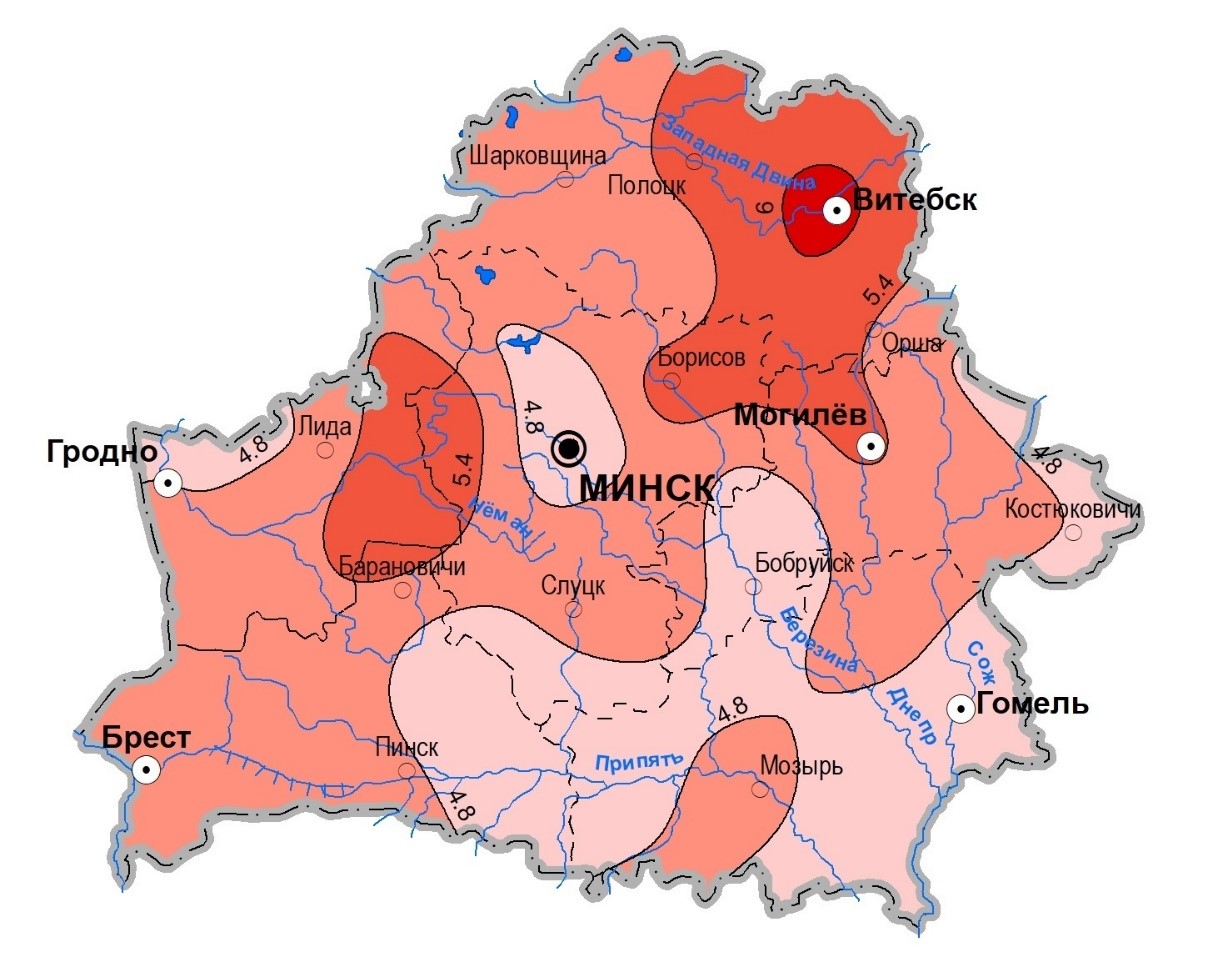
Deviation (°C) of the average March 2026 air temperature
from the climatic norm across the territory of Belarus
Elevated temperature conditions persisted throughout all ten-day periods (decades) of March. The transition of the average daily air temperature above 0 °C (the beginning of climatological spring) occurred 1–2 weeks earlier than usual — as early as the third decade of February. The stable transition above 5 °C (the beginning of the growing season) occurred over most of the country at a record early date (2–4 weeks earlier than normal) on March 8–11.
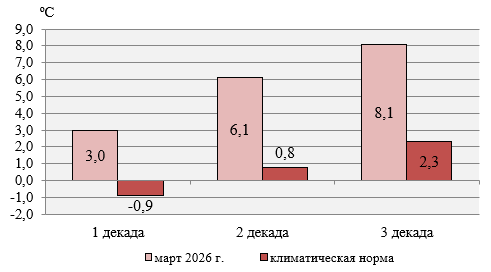
Average air temperature and climatic norm by decade for March 2026
across the territory of Belarus
At the beginning of the month, daytime temperatures ranged from +5 °C to +10 °C; later, air temperatures warmed to +16 °C and higher. The maximum air temperature was reached during the daytime on March 31 at the Kostyukovichi station, reaching +20.0 °C.
Nighttime air temperatures fluctuated between slightly positive and slightly negative values, dropping locally to -5 °C to -9 °C on certain days. The minimum air temperature for the month was recorded at the Klichev station on March 8, reaching -9.2 °C.
March 2026 was anomalously dry, ranking 1st in the ranked series of observations from driest to wettest since 1945. Previously, the driest March in the post-war period was March 2022 (6.0 mm). Over the first spring month of this year, only 3.8 mm of precipitation fell, which is 10% of the climatic norm. At all observation points in the eastern half of the republic, absolute monthly minimum precipitation records were broken. Over most of the country, less than 15% of the climatic norm of precipitation fell and at the Zhlobin and Slavgorod stations, no precipitation was observed during the entire month.
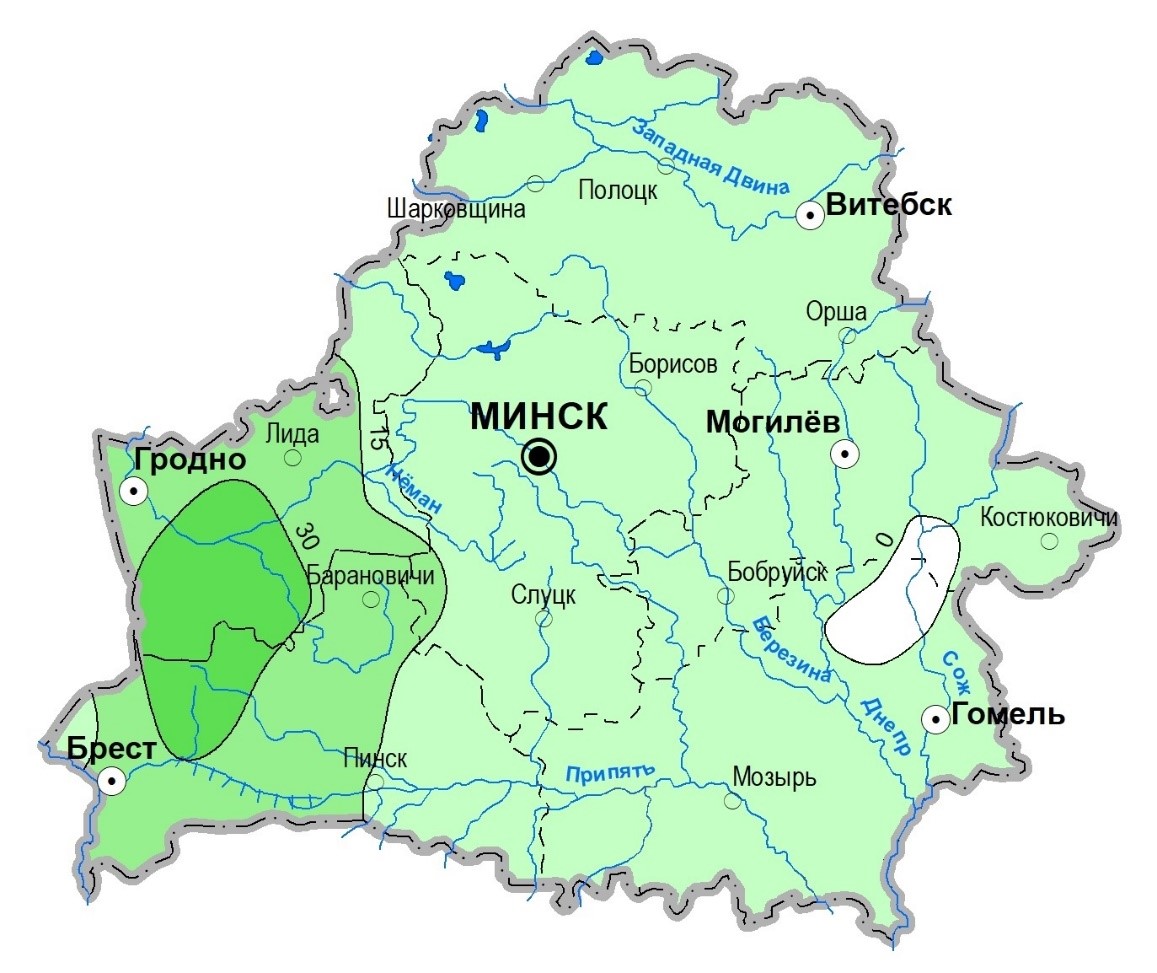
Deviation (%) of the monthly precipitation total for March 2026
from the climatic norm across the territory of Belarus
By region, the highest amount of precipitation was recorded in the Grodno region — 8.7 mm or 23% of the norm. The lowest amounts were recorded in the Gomel and Mogilev regions, where an average of less than 1 mm of precipitation fell per month (0.6 mm and 0.9 mm or 1.5% and 2.4% of the norm, respectively).
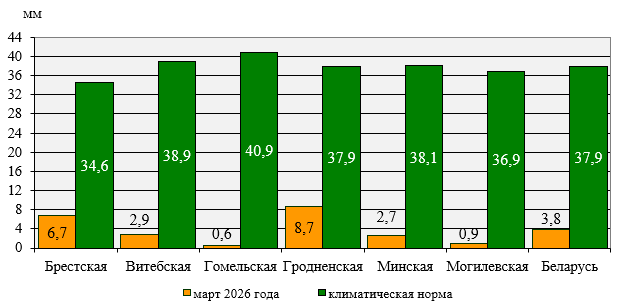
Precipitation amount for March 2026 and the climatic norm
by region and across the territory of Belarus
Throughout all decades of the month, precipitation was recorded in extremely low amounts. In the first decade, 1.5% of the decadal norm fell; in the second decade — 6.2%; and in the third decade — 24% of the decadal norm.
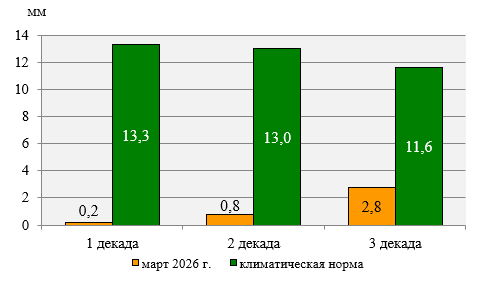
Precipitation amount and climatic norm by decade for March 2026
across the territory of Belarus
Precipitation was rare and short-lived, falling mainly as rain, and locally as wet snow at the beginning of the month. Snow cover completely disappeared during the last decade of the month. The maximum snow depth was recorded on March 1, reaching 45 cm (Kostyukovichi). During the month, fogs and icy phenomena were observed. Increased wind speeds with gusts of 15 m/s or more were recorded in some areas. The maximum wind speed (18 m/s) was registered at the Oshmyany station on March 14.
When using the information a reference to Belhydromet is obligatory
© Belhydromet, 2016-2026