

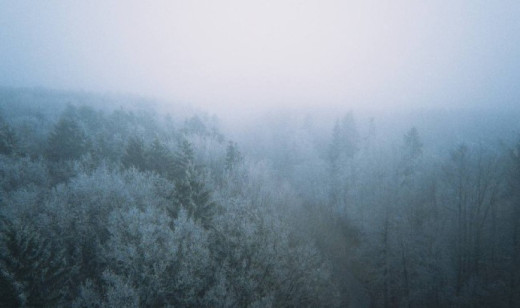
Anthropogenic or industrial snow is a winter phenomenon during which water vapor emissions, usually from an industrial source, lead to local snowfall. Local anthropogenic snow can be observed in cities and towns, depending on the amount of excess water vapor and local meteorological conditions, in the presence of appropriate anticyclonic conditions and near permanent local sources of water vapor and air pollution.
Anthropogenic snow is usually associated with cold, stable anticyclonic conditions, when the radiation fog, held by the inversion layer, does not mix and becomes supersaturated with water vapor. In such conditions, ice nuclei form on motes, which are the smallest suspended particles of industrial pollutants (dust, soot, ash), and precipitation in the form of fine snow falls over a limited area of several square kilometers downwind.
Industrial snow began to be recognized in Europe as a separate local meteorological phenomenon only in recent decades.
At the end of November and in December, residents of some districts of the capital witnessed local snow-white landscapes. However, such snow is of man-made origin and may contain pollutants.
When using the information a reference to Belhydromet is obligatory
© Belhydromet, 2016-2026