

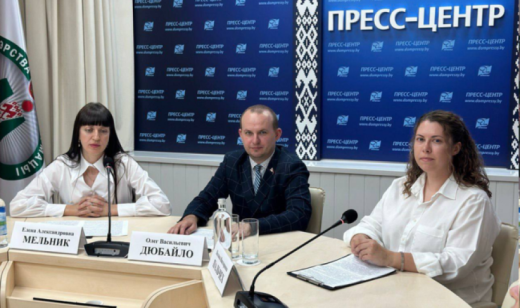
On July 20, 2026, a press conference titled "Radiation Situation in Belarus: Monitoring Results and Safety Guarantees" was held at the Republican Unitary Enterprise "House of Press." Specialists from Belhydromet participated in the event.
The experts presented a detailed analysis for the first half of 2026.

Oleg Dyubailo, Head of the Radiation Monitoring Service.
Radiation monitoring in the Republic of Belarus is conducted in accordance with the "Instruction on the Workflow for the Organization and Implementation of Radiation Monitoring," approved by Order No. 151-OD of the Ministry of Natural Resources and Environmental Protection of the Republic of Belarus dated April 30, 2021.
The objects of observation during radiation monitoring include: agricultural lands, forest fund, soil, atmospheric air, and water bodies.
Radiation monitoring is carried out for the purpose of observing:
- the natural radiation background;
- the radiation background in areas affected by potential sources of radioactive contamination, including for the assessment of transboundary transport of radioactive substances;
- radioactive contamination of atmospheric air, soil, surface and groundwater in territories exposed to radioactive contamination as a result of the Chernobyl NPP accident.
In total, there are 120 radiation monitoring observation points within the National Environmental Monitoring System (NEMS).
The number of observation points and the frequency of measurements are established by the Observation Program for the Natural Radiation Background and Radioactive Contamination of Atmospheric Air, Surface Waters, and Soil at Radiation Monitoring Observation Points for 2026, issued by the state institution "Republican Center for Hydrometeorology, Radioactive Contamination Control, and Environmental Monitoring."
Radiation monitoring of air includes measurements of the dose rate, activity of cesium and strontium, as well as total beta activity in aerosol samples from the ground layer of the atmosphere and atmospheric deposition; determination of gamma-emitting radionuclide content; and determination of strontium content in ground-layer aerosols and atmospheric deposition.
Radiation monitoring of soil includes the determination of cesium and strontium activity in soil.
Radiation monitoring of surface waters includes the determination of total alpha and beta activity, as well as the activity of cesium-137 (Cs‑137) and strontium‑90 (Sr‑90).
For the first half of 2026, more than 11.3 thousand measurements were performed at observation points (hereinafter – OP):
In 2026, no cases of gamma radiation dose rate levels exceeding long-term established values were detected. At 39 out of 41 observation points, the average gamma radiation dose rate ranged from 0.10 to 0.12 µSv/h. Higher gamma dose rate values persist at the Bragin and Slavgorod observation points (located in the zone with the right to resettlement under the Law "On the Legal Regime of Territories Exposed to Radioactive Contamination as a Result of the Chernobyl NPP Accident").
It should be noted that the radiation situation at the Bragin and Slavgorod observation points continues to show a positive trend toward gradual reduction, and the dose rate levels at the Slavgorod observation point in 2026 did not exceed the natural radiation background value for the Republic of Belarus – 0.20 µSv/h.
The total beta activity values in ground-layer atmospheric aerosols and atmospheric deposition at air observation points remained significantly below the established levels.
Radiation monitoring of surface waters includes the determination of total alpha and beta activity, as well as the activity of cesium‑137 and strontium‑90. In 2026, 68 measurements were conducted at 10 observation points. At all surface water observation points, no exceedances of the levels established by the Hygienic Standard (for drinking water) were detected, with the exception of the Nizhnyaya Braginka River for total beta activity.
The higher radionuclide content in the Nizhnyaya Braginka River is due to the fact that its catchment area is located within the Chernobyl NPP exclusion zone.
In the area affected by the Chernobyl NPP, regular environmental monitoring shows that the obtained data correspond to long-term observations and indicate a slow but steady decline in radionuclide activity in environmental objects in the territories affected by the Chernobyl accident, which is attributed to various factors, mainly the natural decay of Chernobyl radionuclides.
Thus, the dose rate at observation points in the Gomel region, except for the Bragin OP, was 0.11 µSv/h, which does not exceed the natural gamma background. At the Bragin OP, seasonal fluctuations in gamma dose rate levels are observed, caused by weather conditions. The average gamma dose rate at the Bragin OP in 2026 was 0.41 µSv/h, which is 0.05 µSv/h lower than last year.
In the area affected by the Belarusian NPP, there are 10 OPs – 3 for air monitoring; 3 for surface water and bottom sediment monitoring; and 4 for soil monitoring.
In 2026, the dose rate at the dosimetric posts of Lyntupy, Naroch, and Oshmyany did not exceed 0.10 µSv/h.
The activity values of cesium‑137 and strontium‑90 in ground-layer atmospheric aerosols and deposition corresponded to established long-term values. No short-lived radionuclides, primarily iodine‑131, which is an indicator of operational disturbances at nuclear facilities, were detected.
Based on the radiation monitoring results, no negative trends were identified; the data for the first half of 2026 correlate well with the results obtained during the construction phase of the Belarusian NPP and correspond to established long-term values.
The work carried out in the field of radiation monitoring allows us to state that the radiation situation in the territory of the Republic of Belarus in the first half of 2026 remained stable.

Elena Melnik, Head of the Environmental Information Service, presented the results of atmospheric air monitoring for the first half of 2026.
The state atmospheric air monitoring network currently includes 87 stationary observation points for atmospheric air quality, of which 51 operate with a discrete (manual) sampling mode, 18 are automatic stations, and 18 are gas analyzers equipped with a set of sensor devices that provide real-time information on the content of priority pollutants in the air. There is also 1 mobile observation point – a mobile air monitoring laboratory – designed for route-based observations to assess air quality in areas where stationary observation points are absent.
In total, atmospheric air monitoring currently covers 26 industrial cities of the republic (including regional centers and the cities of Polotsk, Novopolotsk, Orsha, Bobruisk, Mozyr, Rechitsa, Svetlogorsk, Pinsk, Zhlobin, Lida, Soligorsk, Baranovichi, Borisov, Bereza, Dobrush, Smarhon, Molodechno, Petrikov, Glubokoye, and Osipovichi), as well as the Mozyr industrial hub area (Penyki village) and the Berezinsky Nature Reserve.
For most of the year, the air quality in our cities is fairly favorable, and due to the frequent change of synoptic situations, periods with adverse meteorological conditions that could lead to increased air pollution levels are short-lived.
Based on long-term observations of atmospheric air quality, a certain seasonality in the changes of air pollution levels for specific substances can be identified.
In winter, an increase in air pollution by nitrogen oxides, which are formed as a result of burning various types of fuel, is possible.
Thus, in January, a smog situation was observed in Minsk: on January 20 and 21, automatic air monitoring stations recorded concentrations of nitrogen oxide exceeding the established hygienic maximum permissible concentration (MPC) standards at 5 locations in the city, and dust at 1 location. The highest number of MPC exceedances was observed in the areas of Radialnaya and Timiryazeva streets. Data from manual sampling stations indicated exceedances of the daily average standard for nitrogen dioxide at 5 locations in the city. It should be noted that in most cases, increased air pollution levels were observed in the morning hours – during the period of the most intensive traffic.
This situation was largely due to the prevailing meteorological conditions: calm weather and a strong surface inversion were observed, which hindered the dispersion of pollutants and, consequently, air purification.
As for nitrogen dioxide, exceedances of MPC standards in the first half of 2026 were also recorded in Mogilev and Dobrush.
In spring, an annual increase in the concentration of suspended particulate matter (dust) in the air is observed, and the highest number of MPC exceedances is most often recorded. The reasons for the increased concentrations of particulate matter in the air during this period are a deficit of precipitation, dust raised from non-sodded soil areas, as well as anthropogenic emission sources. During strong wind gusts, dust storms may occur.
In the first half of 2026, the highest number of exceedances of the MPC standard for particulate matter with a fraction size of up to 10 µm (PM10) was observed in Brest and Vitebsk. Exceedances of the PM10 MPC standard were also noted in other cities, but their number was lower.
Exceedances of the MPC standard for particulate matter with a fraction size of up to 2.5 µm (PM2.5) were recorded in Zhlobin and Minsk.
In spring and summer months, an increase in ground-level ozone concentrations is observed. In spring, this is natural and is associated with the seasonal restructuring of the atmosphere and the influx of ground-level ozone from the stratosphere. In summer, ground-level ozone is formed as a result of photochemical reactions in the air involving nitrogen oxides, volatile organic compounds, and other substances (precursors). Ground-level ozone is a secondary pollutant that is not part of emissions from stationary or mobile sources.
In the first half of 2026, the highest number of exceedances of hygienic standards for ground-level ozone was recorded in Brest, Grodno, and Mogilev.
In summer, the problem of increased formaldehyde content in the air becomes relevant: elevated air temperatures trigger photochemical processes that lead to its formation in the atmosphere. A significant portion of formaldehyde, like ground-level ozone, is formed as a result of photochemical reactions involving nitrogen oxides, hydrocarbons, and other substances in the atmosphere. Exceedances of MPC standards for formaldehyde in summer are recorded annually in certain cities.
In June 2026, exceedances of MPC standards for formaldehyde were recorded in the air of 7 cities (Mogilev, Minsk, Grodno, Zhlobin, Novopolotsk, Polotsk, and Pinsk). The highest number was recorded in Mogilev and Grodno; in other cities, mostly isolated exceedances were noted.
Also, short-term exceedances of quality standards for pollutants such as particulate matter (undifferentiated dust/aerosol), carbon monoxide, benzene, and nitrogen oxide were recorded in the air of certain cities.
Information on atmospheric air quality is open and can be accessed on the platform of the Republican Information System for Automated Environmental Monitoring, available at risamos.by, as well as on the Belhydromet website at ww.rad.org.by.
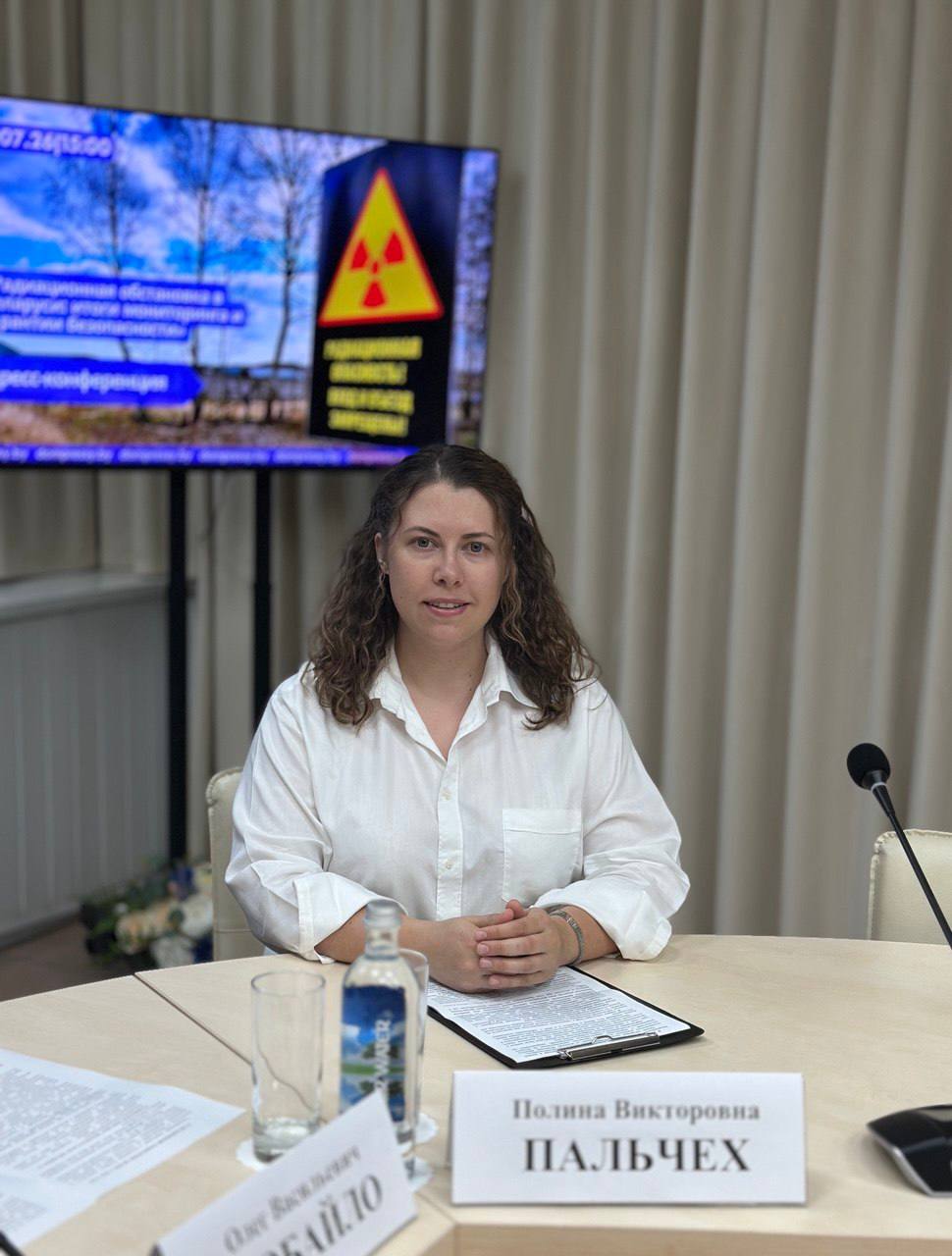
Polina Palchekh, Lead Engineer of the Environmental Information Service.
The purpose of introducing a water body monitoring system is the timely detection of negative processes, prevention of their harmful consequences, and assessment of the effectiveness of measures aimed at the rational use and protection of surface waters.
Observations of the state of surface waters in the republic began in 1947 and were conducted on most major rivers. Over time, the state observation network has significantly expanded, and currently, monitoring covers 160 surface water bodies.
Surface water monitoring is carried out in the basins of the Western Dvina, Neman, Western Bug, Dnieper, and Pripyat rivers, and in 2026, observations cover 227 points.
In the first half of 2026, surface water monitoring was conducted at observation points included in the state register of NEMS observation points for hydrobiological, hydrochemical, chemical indicators for bottom sediments, and hydromorphological parameters.
Observations of surface water quality are carried out by the state institution "Republican Center for Hydrometeorology, Radioactive Contamination Control, and Environmental Monitoring" (hereinafter – Belhydromet) and the state institution "Republican Center for Analytical Control in the Field of Environmental Protection".
The collection, processing, summarization, and analysis of information obtained from environmental monitoring are carried out by Belhydromet.
The observation results for the first half of 2026 indicate that the state of surface waters is generally characterized as good; the content of most observed hydrochemical water quality indicators in surface water bodies is generally within the established quality standards.
Analytical environmental information assessing the state of surface waters is prepared quarterly and posted on the Belhydromet website. Additionally, analytical information on surface water monitoring for 2025, which is part of the environmental state review, has recently been published on the NEMS website.
Detailed analytical information with the results of surface water monitoring observations is posted quarterly on the Belhydromet websites. Annual publications are also issued, containing yearly data on the types of monitoring conducted within the National Environmental Monitoring System in the Republic of Belarus.
In conclusion, it can be stated that the currently existing surface water monitoring system allows for the timely detection and prevention of negative processes and their consequences, as well as the assessment of the effectiveness of measures aimed at the rational use and protection of surface waters.
© Belhydromet, 2016-2026