


Climatic characteristics of winter 2025-2026
The average air temperature for the winter season of 2025/2026 was -5.7 °C, which is 2.3 °C below the climatic norm. Prior to the warming period that began in 1989, winters with such or lower temperatures were observed approximately every second year (48% of years). From 1989 to the present, such winters occur about once every 6-7 years, the last time being in 2010/11. The coldest winter season was 1939/40, with an average seasonal air temperature of -10.9 °C.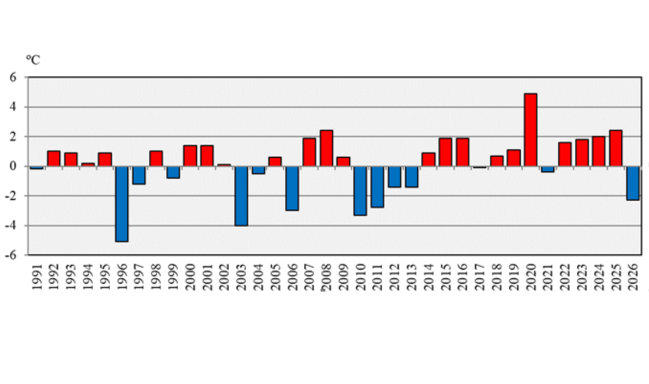
Deviation of the average winter season air temperature from
the climatic norm (-3.4 °C) in the Republic of Belarus
A negative anomaly in seasonal air temperature was observed throughout the country, generally ranging from 1.8 to 2.6 °C.
The largest negative deviations of air temperature from the climatic norm were recorded in the Vitebsk and Mogilev regions (averaging 2.5 °C per region), while the smallest were in the Brest region (averaging 2.0 °C per region).
The maximum air temperature for the season (+13.5 °C) was registered at the Grodno station on February 28 and the minimum (-31.1 °C) was recorded at the Polesskaya station on February 2.
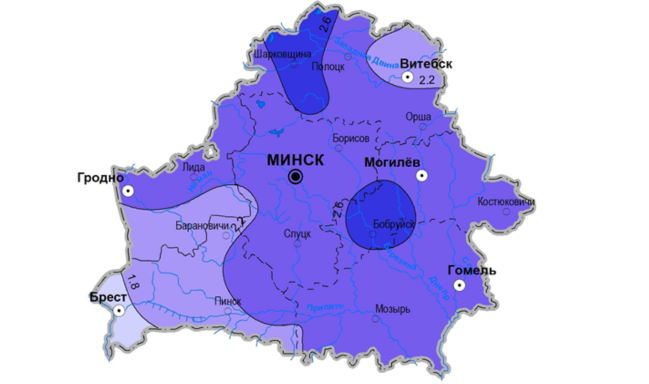
Deviation (°C) of the average winter season air temperature from
the climatic norm in Belarus
The temperature regime of the winter season was uneven. December was warm, with a positive anomaly of 3.0 °C. The average temperature in January and February was below the norm by 6.2 °C and 3.9 °C, respectively.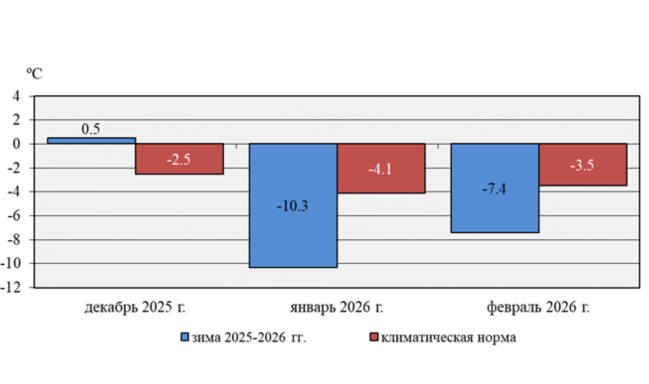
Average air temperature and climatic norm by month for the winter
season of 2025/2026 for the Republic of Belarus
The average air temperature in Belarus for the first winter month was +0.5 °C, which is 3.0 °C higher than the climatic norm. December 2025 ranked 7th in the series of observations from warmest to coldest since 1945 with the 6 warmest Decembers occurring in the current century. The warmest December was in 2006 with an average monthly temperature of +2.6 °C.
The average monthly temperature in January was -10.3 °C which is 6.2 °C below the climatic norm. Prior to the warming period such cold Januarys occurred approximately once every 6 years. Since 1989 such a cold January has been observed for only the second time, after January 2010, with an air temperature of -11.5 °C. The coldest January in the post-war period was January 1987 (-16.3 °C).
The average temperature in Belarus in February was -7.4 °C, which is 3.9 °C below the climatic norm. Such or lower air temperatures in February occur approximately once every 5 years. The coldest February in the last 80 years was February 1956 with an average monthly air temperature of -14.9 °C.
The stable transition of the average daily air temperature below 0 °C (the beginning of climatological winter) occurred on December 13 in the northeastern half of the country and on December 23-24 in the southwestern part, which is one to two decades later than usual.
The amount of precipitation in the winter season was slightly below the climatic norm, with an average of 109 mm of precipitation falling across the country (88% of the climatic norm). The driest winter season was 1953/1954, with 61 mm of precipitation and the wettest was the winter season of 2023/2024 (194 mm).
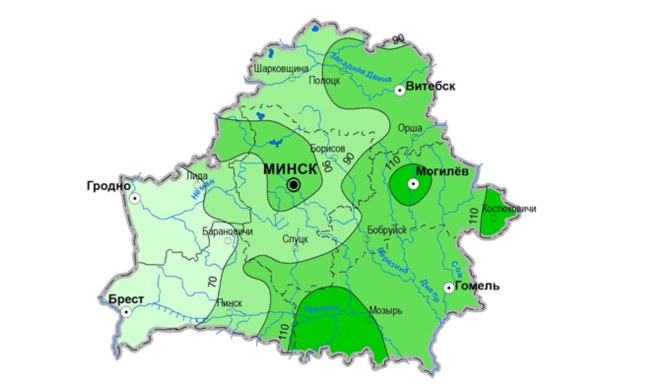
Deviation (%) of precipitation during the winter season
from the climatic norm in Belarus
Precipitation was unevenly distributed across the country. In regional terms, the highest amount of precipitation was recorded in the Gomel region (129 mm or 106% of the norm). The lowest was in the Brest region (76 mm or 67% of the norm).
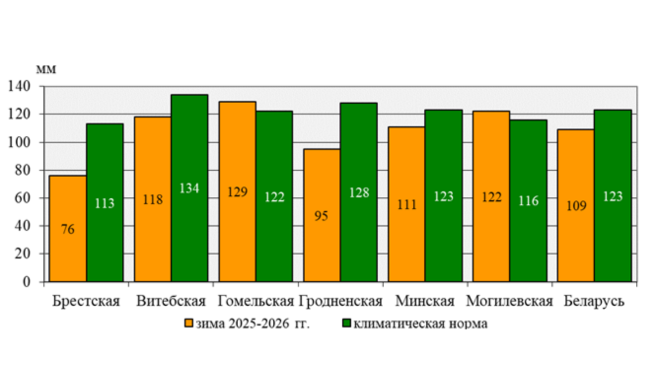
The amount of precipitation over the winter of 2025/2026 and
the climatic norm for the regions and territory of Belarus
Precipitation fell unevenly throughout the winter – a deficit was observed in December and February (81% and 63% of the norm, respectively). In January, the total precipitation exceeded the norm (120%).
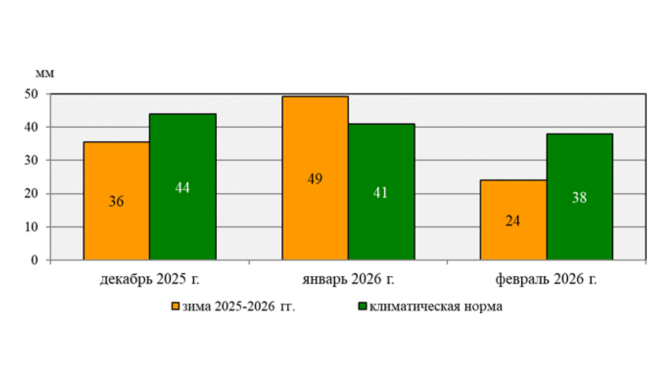
Amount of precipitation and climatic norm
by month for the winter of 2025/2026
In winter, precipitation fell mainly as snow, wet snow and rain. At the end of December, during a cold spell, a stable snow cover formed, reaching a height of up to 18 cm. Due to heavy snowfall in the first ten days of January, the snow cover height increased, reaching 30 cm and higher over most of the territory. Stable snow cover persisted throughout January and February. Temperature conditions and abundant precipitation contributed to the formation of snow cover over most of the country, with heights close to the maximum for the long-term period. Snow cover was unevenly distributed across the republic, with a general trend of decreasing snow height towards the southwest. The maximum snow cover height for the winter season was recorded at the Verkhnedvinsk station on February 14-17, reaching 56 cm. In the last days of February, snow cover completely melted only in the extreme southwestern regions of the country; in the rest of the country, its height ranged from 1 cm (Ivatsevichi) to 46 cm (Kostyukovichi, Verkhnedvinsk).
Throughout the season, fogs, icy phenomena, and, in some areas, blizzards were observed. On January 8 and 9, heavy snowfall was observed across the country and a hazardous phenomenon – very heavy snow with up to 27 mm of precipitation falling (in 12 hours or less) – was recorded at some observation points. On January 29, a hazardous phenomenon was observed near the Zhitkovichi weather station: heavy wet snow accretion with a diameter of 88 mm. Wind gusts intensified to 15 m/s or more and the maximum wind speed for the winter season was recorded at the Pruzhany station on December 28 (21 m/s).
When using the information a reference to Belhydromet is obligatory
Specialized sites
Informational resources
 State Symbols of the Republic of Belarus
 The National Legal Internet Portal of the Republic of Belarus
 The Ministry of Natural Resources and Environmental Protection of the Republic of Belarus
 The Official Internet Portal of the President of the Republic of Belarus
 The Portal for Rating Assessment of the Quality of Services Provided by Organizations in the Republic of Belarus
 The CIS Interstate Council for Hydrometeorology (CIS ICH)
 Information Analysis Portal of the Union State
 The Union State Committee on Hydrometeorology and Environmental Contamination Monitoring
 The Internet Portal "The Youth of Belarus"